Advancement of Materials to Sustainable & Green World
Pages 2303-1724
https://doi.org/10.5185/amlett.2023.031724
Ashutosh Tiwari

Abstract The International Association for Advanced Materials is optimistic that the United Nations' Sustainable Development Goals (SDGs) can be achieved through scientific consideration of circular materials and embracing new green technological advances, as well as by keeping global commitments to reduce climate change, adapt to it, and come up with new ways to deal with it. The present green transition projects rely heavily on the accessibility of biodiversity, climate, and net-zero technologies leading to a sustainable future. A sustainable and green world refers to a global society that operates in harmony with nature, respects ecological limits, and ensures social and economic well-being for present and future generations. It is characterized by responsible resource management, reduced environmental impact, social equity, and the protection of ecosystems. In the context of effective climate resource management, it is necessary to recognize the value of natural materials and incorporate them into ongoing practices and processes. Understanding materials selection, along with leveraging nature-based solutions and renewable technologies, plays a significant role in driving the world's circular economy while ensuring sustainability. Addressing pollution, reducing reliance on non-renewable energy sources, adopting low-carbon materials, and eliminating plastics and harmful chemicals are essential steps toward creating a circular market that connects materials in a circular manner. This approach aligns with SDGs along with the Conference of the Parties (COP), and European Green Deal (EGD), which also emphasizes sustainability, net-zero, and circular processes. In this quest, advancements in climate-efficient materials science and technology, coupled with waste resource innovations, have potential usefulness towards all-in-one green solutions. Thus, it is crucial for the research community to focus on green R&D practices, and topical consortiums as much as possible. By prioritizing climate-efficient materials, promoting sustainable practices, and fostering innovation, the advanced materials world community can work towards materials development goals for a sustainable and green world.
The Known Mechanisms Behind Nanoceria Improved Plant Salt Tolerance
Pages 2303-1725
https://doi.org/DOI:10.5185/amlett.2023.031725
Honghong Wu, Zhaohu Li
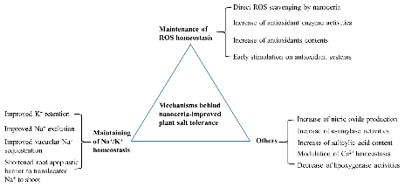
Abstract As a chronic stress, salinity is a global issue threatening agricultural production. Salinity stress limits plant yield and product quality. In terms of providing more tools to help to secure food supply in future, new approaches which can improve crop salt tolerance are encouraged. Nanobiotechnology is a promising approach to improve plant salt tolerance. Nano-improved salt tolerance is widely reported in many plant species, including rice, rapeseed, cotton, cucumber and Arabidopsis etc. To better facilitate the usage of nanomaterials in agricultural production, understanding mechanisms behind nano-improved plant salt tolerance could be a useful approach. In this review, we summarized the known mechanism behind nano-enabled plant salt tolerance, from maintaining ROS homeostasis and Na+/K+ ratio to the modulation at the level of hormones and gas signaling molecules. Also, new possible mechanisms of nano-enabled plant salt tolerance are discussed. Overall, this manuscript aims to help people to better understand the mechanisms behind nano-enabled plant salt tolerance.
Laser-induced Micro-explosion: A Micro-zone Explosive Simulator for the Characterization of Explosives
Pages 2303-1726
https://doi.org/10.5185/amlett.2023.031726
Xianshuang Wang, Ruibin Liu
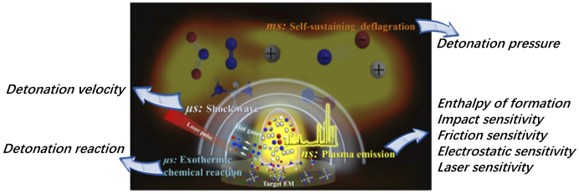
Abstract The determination of detonation performance and sensitivity is an important research content of explosive testing technology. However, the traditional test method usually requires a large amount of samples due to the limitation of the critical diameter and other detonation conditions. Therefore, it will inevitably bring great test risk, high test cost and measurement uncertainty. In this case, it is urgent to develop new testing technology with small dosage and high precision. Recently, a micro-zone explosive simulator for the characterization of explosives is proposed by Wang and Liu et.al. According to their work, laser-induced micro-explosion is produced by micrograms of explosives irritated by pulsed laser, has been proved to be closely related to macroscopic detonation. Therefore, it can be used as a micro-zone explosive simulator for the characterization of explosives. The aim of this letter is to shed new light on the determination of detonation performance and sensitivity and highlighted the importance of close integration of experimental, statistical, and theoretical efforts.
Effects of Initial Surface Roughness and Sliding Speed Study on the Tribological Characteristics of AA6061 and CuZn37Pb2 Alloys
Pages 2303-1727
https://doi.org/10.5185/amlett.2023.031727
Bougoffa M. Seyf Eddine, Sayhia Benchaa
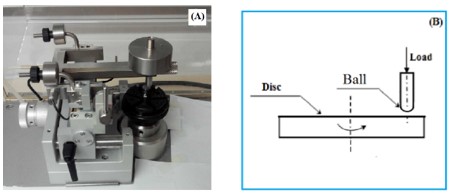
Abstract The paper examines the influence of initial surface roughness and sliding speed on friction and wear behavior of AA6061 aluminum alloy and brass alloy (CuZn37Pb2) under dry contact using a CSM tribometer. Surface roughness of materials studied were measured using optical profilometer. Rough surfaces (Ra=0.37 - 1.33 μm) were prepared on two materials: AA6061 and CuZn37Pb2 alloy. Track width, wear rate, and wear loss values were assessed and contrasted with changes in coefficient of friction values at various starting surface roughness and sliding speeds. Experiments are conducted at sliding speed 0.15;0.24;0.35 and 0.48 m/s. wear track diameter 4;6;8;10 mm. Results show that wear loss, wear rate and track width of CuZn37Pb2 and AA6061 increase at high initial surface roughness and speed but the value of friction coefficient decreases. Various SEM analysis of the wear trace and worn surfaces for each alloy at different sliding speed were analysed and compared.
Influence of NbC Addition in Aluminium Alloy A380 on Microstructure at Semi-Solid Processing Temperature
Pages 2303-1728
https://doi.org/10.5185/amlett.2023.031728
Bruno Edu Arendarchuck, Luciano Augusto Lourençato, Hipolito Domingo Carvajal Fals, Alexia Wan Der Haagen
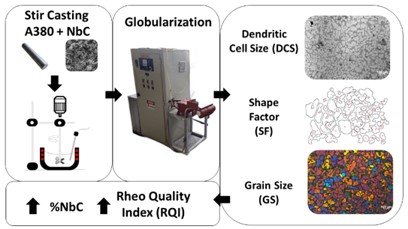
Abstract Semi-solid processing is a promising technique used to fabricate parts, minimize manufacturing steps post preparation, and reduce casting defects. The globular structure is the key in this process, a characteristic achieved with the partial remelting of material to temperatures between solidus and liquids. In this sense, the aim of this research is to evaluate the microstructure quality of the aluminium matrix composite (AMC) reinforced with NbC, after semi-solid treatment. Micron-sized NbC powder with 0 wt. %, 5 wt. %, 10 wt. %, and 15 wt. % was employed as reinforcement, to fabricate a composite through the stir casting method. Furthermore, was used an Al-5Ti-1B alloy grain refinement. Globularization heat treatment at 562 °C, with a holding time of the 90s, was realized. An optical microscope under conventional and polarized light and a scanning electron microscope (SEM) allows the microstructure analyses. The dendritic cell size (DCS), grain size (GS), shape factor (SF), and rheo quality index (RQI) were used to analyse the morphology and microstructure. The results show a general reduction of GS and DCS parameters with a higher amount of NbC. The AMC with NbC shows more globular microstructure when compared with non-reinforced alloy.
Antioxidant and Anti-inflammatory Activities of Polysaccharides from the Coat of Fermented and Unfermented Sugar Apple (Annona squamosa L.) Seed
Pages 2303-1729
https://doi.org/10.5185/amlett.2023.031729
Christianah Adebimpe Dare, Oluokun Oluboade Oyedapo
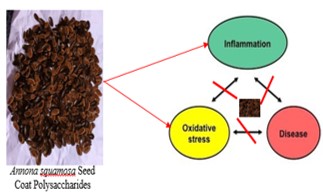
Abstract This study explored the effect of fermentation on the antioxidant and anti-inflammatory activities of polysaccharides from seed coat of fermented and unfermented Annona squamosa seed. Fresh and ripe sugar apple fruits were collected from a tree in Ota-Efun, Osogbo, Nigeria (07o 32’ 30.2496” N, 04o 31’ 41.7036” E) and their identities were verified at IFE Herbarium, Department of Botany, Obafemi Awolowo, University, Ile-Ife, Nigeria. The seeds were collected and divided into two portions: fermented and unfermented. The coats of both the fermented and unfermented seeds were defatted with n-hexane separately. Polysaccharides were extracted from the defatted samples using cold and hot water procedure according to standard methods to give fermented seed coat polysaccharides and unfermented seed coat polysaccharides. Antioxidant and anti-inflammatory activities of the polysaccharides were investigated using standard methods. The reducing power, metal chelating, DPPH radical scavenging, inhibition of albumin denaturation, membrane stability potentials of the polysaccharides revealed the efficacy of the polysaccharides to take care of free radicals and maintain the integrity of the cell membrane and the fermented seed coat polysaccharide was the best. This study concluded that the polysaccharides from A. squamosa seed coat have great potential as antioxidant and anti-inflammatory agents to combat diseases related to oxidative stress, and fermentation enhanced the bioactivity of the polysaccharides.
Thermionic Emission Induced Current-Voltage behaviour of GdMnO3/Al:ZnO/STO and GdMnO3/ZnO/STO Thin Film Heterostructures
Pages 2303-1730
https://doi.org/10.5185/amlett.2023.031730
Pankaj Solanki, Mayur Vala, Sandip V. Bhatt, Dhananjay Dhruv, Bharat Kataria
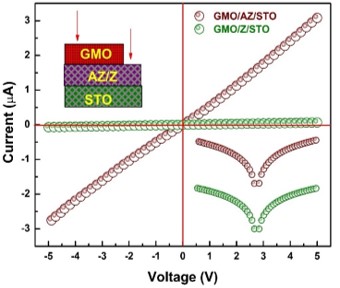
Abstract We report the results of studies on the rectifying behaviour and tunnelling conduction in GdMnO3/ZnO/STO and GdMnO3/Al:ZnO/STO thin film heterostructures comprising of p-n junctions fabricated using the Pulsed Laser Deposition (PLD) technique. A structural study using grazing angle mode XRD depicts polycrystalline growth and confirms the phase purity. The AFM micrographs reveals the different grain growth and grain sizes of the prepared thin film heterostructures. Room temperature Raman spectra shows the presence of various vibrational modes in both the thin film heterostructures, the transport studies using I–V measurements at room temperature is explained using various models. The temperature dependent transport studies using I-V measurements at various temperatures reveal the rectifying behaviour and the difference in the I-V behaviour at various temperature can be understood on the basis of interface effect at the junction, which has been attributed to the presence of the various conduction phenomena through the junctions and the change in barrier height with the temperature for both presently studied thin film heterostructures.