Researcher of the Year 2019: Professor Enge Wang – A Legendary Researcher of Atomistic World
Pages 850-854
https://doi.org/10.5185/amlett.2019.1012
Ashutosh Tiwari

Abstract International Association of Advanced Materials (IAAM) proudly announces ‘Researcher of the year’ award every year to recognize the contribution of scientists towards the advancement of materials for global excellence. This year, the award is presented to eminent physicist Prof. Enge Wang, Vice President of Chinese Academy of Sciences (CAS) and President Emeritus of Peking University, China, for his contribution towards the nanotechnology research and innovations. He is one of the leading contributors in the field of surface physics; the approach is a combination of atomistic simulation of nonequilibrium growth and chemical vapor deposition of light-element nanomaterials. © VBRI Press.
Graphene in Russia: The Main Centers, Research Areas, Results
Pages 855-859
https://doi.org/10.5185/amlett.2019.2272
Grachev Vladimir, Gubin Sergey
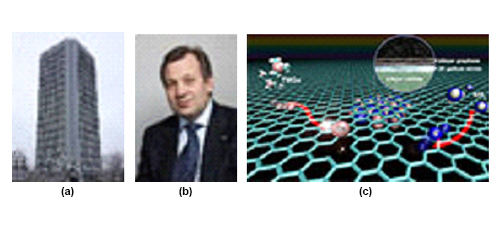
Abstract Russian graphene research centers are presented, in which the most significant results were obtained. The cities, scientific groups, their leaders, main research areas are listed: methods of synthesis and diagnostics of graphene and graphene-like structures, theoretical methods in the application to graphene materials, devices based on graphene and related structures - sensors of physical characteristics, fuel cells, biosensors etc., the application of graphene and related 2D materials in electronics, photonics, spintronics, optoelectronics, bioelectronics. The large-scale production of graphene and graphene-like structures is also covered. The main sources of publications of Russian researches and their colleagues are also listed. Copyright © VBRI Press.
Principles and practices of Si light emitting diodes using dressed photons
Pages 860-867
https://doi.org/10.5185/amlett.2019.2264
M. Ohtsu, T. Kawazoe
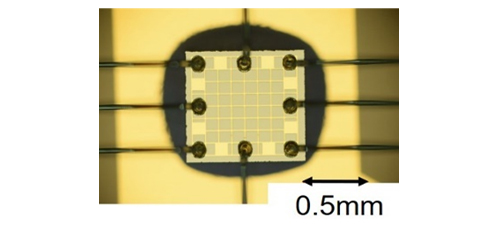
Abstract This paper reviews basic research and technical developments on silicon (Si) light-emitting diodes (Si-LEDs) fabricated by using a novel dressed-photon–phonon (DPP)-assisted annealing method. These devices exhibit unique light emission spectral profiles in the wavelength range 900–2500 nm, including novel photon breeding features. The highest optical output power demonstrated was as high as 2.0 W. It is pointed out that boron (B) atoms, serving as p-type dopants, formed pairs whose length was three-times the lattice constant of the host Si crystal. These B atom pairs are the origin of the photon breeding. It is pointed out that photon breeding took place with respect to photon spin. Furthermore, recent measurements show that the B atom pairs tend to form a chain-like configuration. Copyright © VBRI Press.
Dual Effect of Light Irradiation for Surface Relief Gratings Formation in Se-rich Ge-Se Thin Films
Pages 868-873
https://doi.org/10.5185/amlett.2019.0012
Tyler Nichol, Janis Teteris, Mara Reinfelde, Maria Mitkova
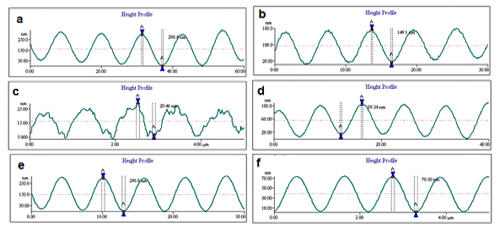
Abstract Relief surface formation as a result of light irradiation is one important property of chalcogenide glasses which gives rise of number of applications. Understanding the nature of the process is an essential step towards optimization of the relief images obtained. This work depicts the mechanisms for surface relief grating formation in Ge-Se thin films exposed to diffracted light. A dependence on the period of the illumination source is revealed, which correlates with the composition of the thin film material. Raman spectroscopy, Energy Dispersive Spectroscopy (EDS), and Atomic Force Microscopy (AFM) were used to analyze the films. The results point towards a dual effect of light irradiation leading to mass transport and structural changes, which results in a surface relief formation. Copyright © VBRI Press.
Synthesis, Structural Characterization, Dielectric and Piezoelectric Properties of Multiferroic Double-perovskite Bi2FeMnO6 Ceramics
Pages 874-879
https://doi.org/10.5185/amlett.2019.0008
Peng Song, Zhipeng Pei, Heng Wu, Yao Lu, Weiren Xia, Xinhua Zhu
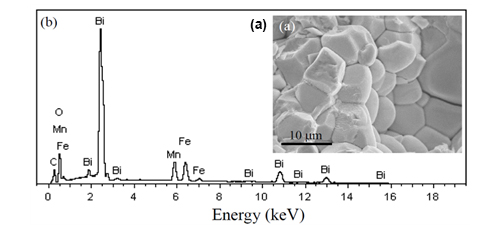
Abstract Double-perovskite structured multiferroic Bi2FeMnO6 (BFMO) ceramics synthesized via solid-state reaction route at 880 o C for 3 h, crystallized in a distorted rhombohedral structure with R3c space group. Their lattice parameters in the hexagonal system were determined to be a = 5.571 Å and c = 13.191 Å. SEM images show that the BFMO ceramic grains exhibit spherical morphology with an average size of 6.70 mm. Their atomic ratio of Bi:Fe:Mn was determined to be 2.07:1.02:1.00, close to the nominal value of 2:1:1. Raman spectra have verified the vibrational frequencies in the BFMO ceramics, and only 11 Raman active modes are observed. The less observed Raman modes in the BFMO ceramics compared with the theoretical group analyses, can be ascribed to the small correlation field splitting of the ceramic samples due to their polycrystalline nature. BFMO ceramics exhibit almost frequency-independent dielectric behavior in a frequency range of 500 - 10 6 Hz at room temperature. Their dielectric constant and dielectric loss were measured to be 700 and 0.03 at 10 6 Hz, respectively. The piezoelectric moduli d33 of the poled BFMO ceramics was measured to be 56 pC/N, which is two times larger than that reported for BiFeO3 thin film (d33 ≅ 25 pC/N). Copyright © VBRI Press.
Anisotropic and Nonlinear Mechanical Properties in Two-dimensional Nanomaterials
Pages 880-886
https://doi.org/10.5185/amlett.2019.0051
Ming Yu, Congyan Zhang, Safia Abdullah R Alharbi, Anna Zeng, Kevin Zeng, Emily Liu
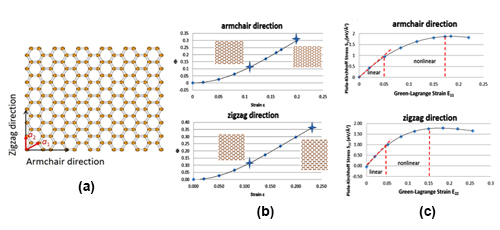
Abstract A systematic computational calculation based on the state-of-the-art quantum mechanics mothed was carried out to study the response of mechanical properties to various strains exerted on graphene, SiC sheet, and recently predicted two-dimensional (2D) sandwiched GaP and InP binary compounds. It was found that these 2D materials undergo an elastic expansion, a structural deformation, and then a structural broken process as the strain increases. Such process strongly depends on the direction of the strain exerted on 2D materials. In particular, a phase transition occurs in 2D sandwiched GaP and InP binary compounds when the strain exerts in zigzag direction. Calculated mechanical properties show that graphene has large linear and nonlinear elastic moduli, followed by 2D SiC monolayer. While the sandwiched GaP and InP structures possess significant anisotropic and nonlinear mechanical properties. Especially, those constants in the zigzag direction are about three to nine times greater than that in the armchair direction. Compared to graphene, they are softer, even along the zigzag direction. Such results provide fundamental information at atomic level for synthesizing, designing, and fabricating nanoelectromechanical and nanoelectronic devices. Copyright © VBRI Press.
Anisotropy of Mechanical Properties of an AZ31 Alloy Prepared by SPD Method
Pages 887-892
https://doi.org/10.5185/amlett.2019.0037
Zuzanka Trojanová, Zdeněk Drozd, Kristián Mathis, Michal Kövér, Ján Džugan, Pavel Lukáč, Kristýna Halmešová
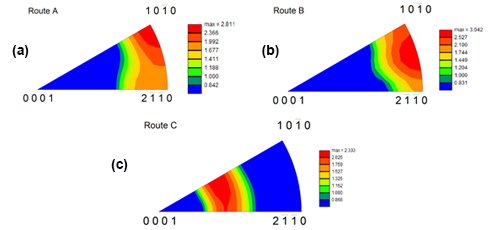
Abstract Cast magnesium alloy AZ31 was processed by equal channel angular pressing (ECAP); 1-8 passes were applied using different processing routes A, BC and C. Samples were cut from the extruded billet in the extrusion, transversal and normal directions. Micro-tensile tests were performed at room temperature with an initial strain rate of 1´10 -3 s -1 . The microstructure analysis showed a significant grain reducing. Texture of extruded samples was studied using EBSD technique. The true stress-true strain curves and characteristic stresses exhibit a pronounced anisotropy for all processing routes as a consequence of the developed different texture. Copyright © VBRI Press.
Validation of Advanced Constitutive Models for Accurate FE Modeling of TPU
Pages 893-898
https://doi.org/10.5185/amlett.2019.0031
Robert Eberlein, Lucian Pasieka, Dimosthenis Rizos
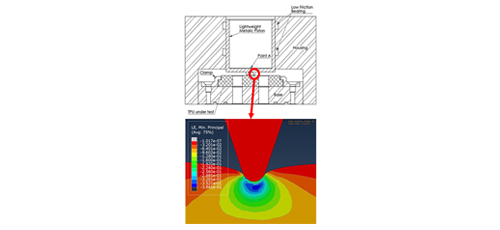
Abstract Thermoplastic polyurethanes (TPU) have become preferred materials for demanding high strain rate applications in many industries throughout past years. Due to their comparatively high abrasion resistance and toughness, TPU materials form an excellent fit for critical components sustaining high pressures in combination with harsh ambient conditions. This presentation illustrates a comparatively new field of critical applications for TPU components. While the operational pressures remain rather moderate at maximum 50 bar, challenges arise from high-frequency, cyclic loading conditions. In order to design robust dynamic TPU components, two main tasks must be accomplished: (i) visco-elastic-plastic material modeling and parameter identification, and (ii) material validation under realistic dynamic loading conditions on system level by means of advanced finite element (FE) simulations. This article puts (i) emphasis on the material calibration process and (ii) specifically demonstrates material validation on system level for selected TPU materials. In this context strain rate dependency of various TPU grades is discussed, which illustrates deficiencies of classical material modeling techniques available in commercial finite element software versus advanced nonlinear models. Eventually, recommendations are provided for an efficient but also accurate material calibration process of solid TPU materials that can significantly enhance product innovation processes. Copyright © VBRI Press.
Alignment of Rods and Flakes using Electric Field
Pages 899-902
https://doi.org/10.5185/amlett.2019.0020
Rongshan Qin
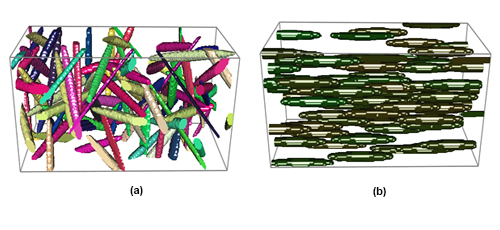
Abstract Electrically neutral anisotropic objects can be aligned by the applied electric field. The required processing conditions include to submerge the objects in a matrix with higher electrical conductivity than that of the objects and to apply electric field to the suspension. The objects may be in rod, disk, flakes or other anisotropic shapes. Carbon nanotubes, silicon nanowires, micro coils, DNA and many bacteria can be approximated as rod-like shape, and graphene can be considered as a shape of flake. A fundamental investigation to this phenomenon has been carried out in the present work. Numerical calculation based on thermodynamics shows a confirmative trend to use electric field to align those materials. The driving force in the alignment processing is an equivalent configuration force dependent on the discrepancy between the electrical properties of the anisotropic particles and matrix. Copyright © VBRI Press.
Shape Memory Polymer Composites for Long-Term Exposure to Space Environment
Pages 903-906
https://doi.org/10.5185/amlett.2019.0007
Fabrizio Quadrini, Denise Bellisario, Giovanni Matteo Tedde, Loredana Santo
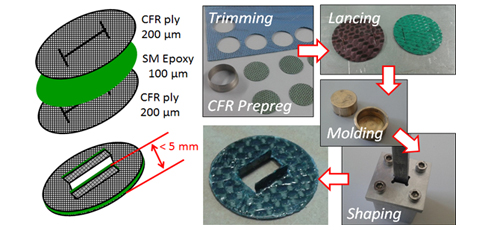
Abstract Shape memory polymer composite (SMPC) samples for long-term exposure in Space environment have been designed and tested. SMPC laminates consisted of two carbon fiber reinforced (CFR) plies and a SMP interlayer. Samples were manufactured by prepreg lamination and molding with subsequent thermomechanical processing for shape change. Commercial raw materials were selected both for CFR plies and SMP interlayer. Differential scanning calorimetry and dynamic mechanical analysis have been used to evaluate the thermo-mechanical behavior of the SMPC laminate in comparison with the neat CFR laminate and the SM epoxy resin of the interlayer. Results show that the hybrid nature of the SMPC laminate is responsible for their good shape memory behavior. A small disk with a simple shape change has been prepared to be integrated in the MISSE-FF platform for long-term exposure to Space environment. Recovery tests under IR light exposure highlighted the optimal functional behavior of this kind of sample. Copyright © VBRI Press.
In-soil Biodegradation Behavior of Chitosan-Coated Phosphorylated Starch Films
Pages 907-912
https://doi.org/10.5185/amlett.2019.0017
Danila Merino, Vera A. Alvarez
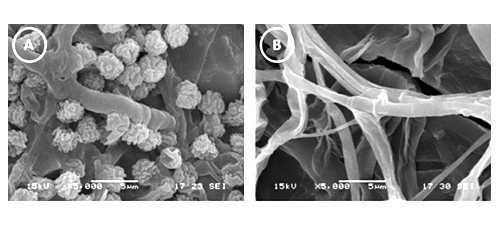
Abstract Novel starch-based films were previously proposed as agricultural mulches and their main properties were critically addressed. In this report, the effects of chemical modification by crosslinking (phosphorylation) and surface functionalization with chitosan on corn starch-films biodegradability were studied. The biodegradability assay was performed in soil using a professional substrate. The biodegradation and disintegration of samples were followed by measuring their weight loss (WL), water sorption (WS) and changes in appearance (by photographs). Additionally, changes in surface morphology at microscopic level were investigated by scanning electron microscopy (SEM), while structural and chemical changes were evaluated by Fourier transform infrared spectroscopy (FTIR) and thermogravimetric analysis (TGA). Results indicate that neither the chemical modification by phosphorylation, nor the chitosan-functionalization of the surface produced changes in films biodegradation time, which is a positive result. All materials degrade almost completely in three months following a three-step mechanism that involves plasticizer leaching, microbial development, bio-erosion of the surface and the starch molecular weight diminution. Copyright © VBRI Press.
Adaptive FRP Structures for Exterior Applications
Pages 913-918
https://doi.org/10.5185/amlett.2019.0029
Larissa Born, Axel Körner, Anja Mader, Gundula Schieber, Markus Milwich, Jan Knippers, Götz T. Gresser
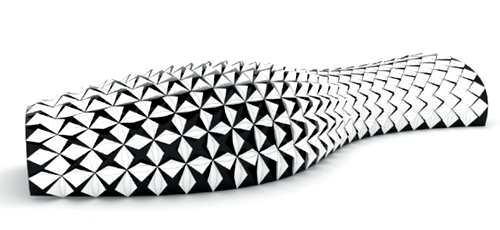
Abstract Regarding modern, daylight-flooded buildings with large window façades, appropriate shading systems to improve the energy consumption of climate controlling systems are becoming more relevant. Building envelopes contribute largely to the temperature control and should be at best installed on the outside to prevent the interior from heating up. Preferably, those systems work with minimum maintenance and maximum robustness, covering as much of the window area as possible. Previous shading systems were mostly based on rigid-body mechanisms using error-prone joints. Components, whose movability is achieved by a local compliance of the material, offer a way to avoid the usage of mechanical joints. Within this paper, a new fiber-reinforced plastic (FRP) façade shading demonstrator called “Flexafold” is presented. Its opening and closing movement are controlled by pneumatic cushions which are integrated directly into the laminate set-up. The Flexafold shows thereby the possibility of producing self‑supporting, adaptive FRP components whose actuators are integrated into the component and thus protected in exterior applications. The functional principles and components of Flexafold, e.g. the locally compliant FRP material, the folding pattern and the integrated actuator system, are explained within this paper. Furthermore, a comparison to existing adaptive façade shading systems “flectofin ® ” and “Flectofold” is given. Copyright © VBRI Press
Characterization of Plasma Activated Water for Medical Applications
Pages 919-923
https://doi.org/10.5185/amlett.2019.0041
P.S Ganesh Subramanian, R. Harsha, D.K. Manju, M. Hemanth, R. Lakshminarayana, M.S. Anand, S. Dasappa
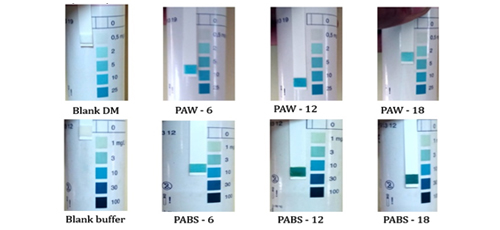
Abstract Non-thermal plasma discharge in air generates several species, including reactive oxygen and nitrogen species (RONS). If, plasma is generated above a water column, some of these species gets transferred into the water column below generating plasma activated water (PAW), which is known to have several applications. These applications are attributed to the reactive species generated by the plasma discharge. To cater specifically to each application, a complete chemical characterization of plasma discharge in air and PAW is vital, as each of these species have their own unique contribution to the application of PAW. In this work, analysis of the plasma discharge in air using optical emission spectroscopy (OES) and detailed characterization of PAW for its chemical constituents was done. In PAW, the parameters namely, pH, electrical conductivity , , and were quantified as a function of plasma exposure time. The values of ( ) and ( ) obtained in this study were about 50% and 130% higher respectively, than what has generally been reported. The antimicrobial nature of the PAW on Pseudomonas aeruginosa, one of the bacteria responsible for nosocomial infections was also tested, and PAW was able to inactivate the bacterium. Copyright © VBRI Press.