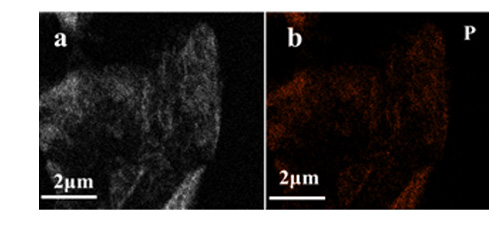
The red phosphorus is considered as a promising anode material for sodium-ion batteries (SIBs) due to its high theoretical capacity of 2596 mAh/g. However, red phosphorus suffers from some limitations, such as low electronic conductivity, and huge volume expansion in the process of discharging. Herein, we report a high-performance anode with red phosphorus (rP)/reduced graghene oxide (rGO) nanocomposite via vaporization-condensation method. The resulting nanostructured rP is uniformly distributed on the surfaces of rGO. The obtained rP/rGO anode achieves high reversibility (76.85% initial columbic efficiency), high specific discharge capacity (1582.3 mAh/g at 260 mA/g), stable cycling performances (60.2% capacity retention after 50 cycles), and high rate performances (up to 7800 mA/g current density). These high performances of our nanocomposite materials suggest that the rP/rGO anode is of great potential for future high energy SIBs.
Li, M., Dou, S., Feng, N., Pu, X. & Hu, W. (2018). Phosphorus/reduced graphene oxide nanocomposite for high-performance anode of sodium-ion batteries . Advanced Materials Letters, 9(5), 331–335. https://doi.org/10.5185/amlett.2018.1871
MLA
Li, M., Dou, S., Feng, N., Pu, X., & Hu, W. "Phosphorus/reduced graphene oxide nanocomposite for high-performance anode of sodium-ion batteries ", Advanced Materials Letters, 9, 5, 2018, 331–335. doi: 10.5185/amlett.2018.1871
HARVARD
Li, M., Dou, S., Feng, N., Pu, X., & Hu, W. (2018). 'Phosphorus/reduced graphene oxide nanocomposite for high-performance anode of sodium-ion batteries ', Advanced Materials Letters, 9(5), pp. 331–335. doi: 10.5185/amlett.2018.1871
CHICAGO
Li, M., Dou, S., Feng, N., Pu, X. & Hu, W., "Phosphorus/reduced graphene oxide nanocomposite for high-performance anode of sodium-ion batteries ." Advanced Materials Letters, 9 5 (2018): 331–335, doi: 10.5185/amlett.2018.1871
VANCOUVER
Li M., Dou S., Feng N., Pu X., Hu W. Phosphorus/reduced graphene oxide nanocomposite for high-performance anode of sodium-ion batteries . Adv. Mater. Lett. 2018;9(5):331–335. doi: 10.5185/amlett.2018.1871