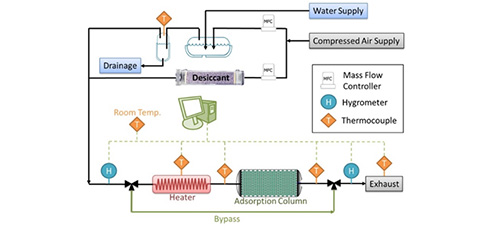
Thermal energy storage (TES) by water vapor adsorption process has attracted increasing interest for its thermal applications such as space heating and cooling. However, the experimental energy density of the adsorbents may vary as the operating system and conditions change, which could be much lower than the theoretical energy density. In this manuscript, an experimental system has been designed and built to examine the effects of the regeneration temperature and relative humidity (RH) on a commercial silica gel material’s performance as adsorption TES material. The experimental energy density under different operating conditions were calculated. Up to 25 adsorption-desorption cycles were performed to examine the stability of the material and the repeatability of the results.
Hua, Y., Godin, A. & Handan Tezel, F. (2019). Water vapor adsorption in silica gel for thermal energy storage application. Advanced Materials Letters, 10(2), 124–127. https://doi.org/10.5185/amlett.2019.2181
MLA
Hua, Y., Godin, A., & Handan Tezel, F. "Water vapor adsorption in silica gel for thermal energy storage application", Advanced Materials Letters, 10, 2, 2019, 124–127. doi: 10.5185/amlett.2019.2181
HARVARD
Hua, Y., Godin, A., & Handan Tezel, F. (2019). 'Water vapor adsorption in silica gel for thermal energy storage application', Advanced Materials Letters, 10(2), pp. 124–127. doi: 10.5185/amlett.2019.2181
CHICAGO
Hua, Y., Godin, A. & Handan Tezel, F., "Water vapor adsorption in silica gel for thermal energy storage application." Advanced Materials Letters, 10 2 (2019): 124–127, doi: 10.5185/amlett.2019.2181
VANCOUVER
Hua Y., Godin A., Handan Tezel F. Water vapor adsorption in silica gel for thermal energy storage application. Adv. Mater. Lett. 2019;10(2):124–127. doi: 10.5185/amlett.2019.2181